
Smile Makeover vs. Simple Bonding and Whitening: What Actually Lasts?
Wondering if a smile makeover is better than simple bonding or whitening? Discover what actually lasts and book your consult at Bellflower Dental Group today!
Read More
Simple bonding and whitening can address individual concerns, but they come with hidden long-term costs — biological and aesthetic. A comprehensive smile makeover coordinates treatments so results stay consistent and durable for years, not months.
For Bellflower-area patients, here's a counterintuitive reality: whitening and bonding don't always age the same way.
When you whiten your natural enamel and add composite resin bonding in the same appointment, both look great on day one. The problem surfaces 6 to 12 months later. Natural enamel continues to absorb stains from coffee, wine, and tea. Composite resin does not bleach — it holds its original shade regardless of how many whitening trays you use afterward. The result is a patchy, two-tone smile that grows more noticeable over time.
According to WebMD, bonding material is more likely than other restorations to stain or wear down — and whitening products cannot correct that drift once it starts. Patients end up on a perpetual bleaching schedule just to keep their natural teeth aligned with the static shade of their bonded areas.
A comprehensive smile makeover sidesteps this entirely. Porcelain veneers or ceramic restorations are shade-matched before placement and maintain chromatic stability long-term. Your dentist locks in a single, consistent color across every visible tooth — no ongoing maintenance bleaching required to keep things looking even.
If you choose whitening plus minor bonding, build in the expectation that shade management becomes a recurring task, not a one-time fix.
Not every bonding failure is the patient's fault. Some are biomechanical inevitabilities.
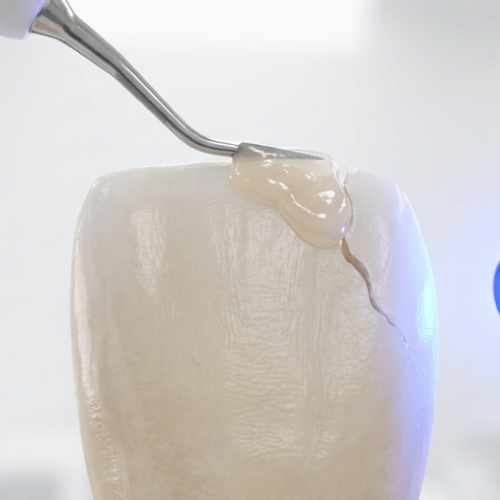
Composite resin bonded to incisal edges — the biting surfaces of your front teeth — absorbs significant force every time you chew or clench. Patients with bruxism, an edge-to-edge bite, or a deep overbite place destructive lateral forces on those surfaces. Simple bonding cannot redistribute that load. It chips. You repair it. It chips again. The cycle repeats.
A smile makeover addresses this differently. Restorations are designed around your existing bite pattern, sometimes adjusting anterior guidance so forces spread across multiple teeth rather than concentrating on one vulnerable edge. As Cleveland Clinic explains, dental bonding is best suited for small cosmetic changes and areas of low bite pressure — typically the front of the mouth under ideal conditions. Once bite dynamics complicate the picture, the material's limitations become structural, not just cosmetic.
If you've had the same tooth bonded more than twice, that's a signal worth discussing with your dentist. The issue may not be the bonding technique — it may be that bonding was never the right tool for that specific bite situation. In some cases, a tooth crown may be the more appropriate and durable solution.
Most comparisons between bonding and a full makeover focus on the upfront difference. That framing misses the longer arc.
Composite resin typically lasts three to ten years before needing replacement, according to Healthline. Each replacement cycle involves re-etching and reshaping the tooth surface to help new resin adhere. Over two decades, those repeated preparations gradually reduce the natural enamel available. Eventually, the tooth may require a veneer or crown regardless — meaning the patient ends up at a more involved restoration anyway, but after years of incremental enamel loss and multiple repair appointments. Patients who also develop decay during this period may need cavity fillings alongside their cosmetic repairs, adding further complexity to an already layered treatment history.
The American Dental Association's Mouth Healthy resource notes that veneers require removing a small amount of enamel for placement — but that removal is controlled, planned, and done once. The biological trade-off of a one-time, well-designed makeover often compares favorably to the cumulative enamel loss from repeated bonding repairs over the same period.
Whitening alone carries its own ceiling. Cleveland Clinic notes that pro teeth whitening can deliver meaningful shade improvement, but results require ongoing maintenance — and whitening cannot address chips, gaps, or shape irregularities at all. For patients whose concerns go beyond color, whitening is an incomplete answer.
The practical question isn't which option requires less treatment upfront. It's which option delivers stable, lasting results without requiring repeated interventions that gradually compromise the tooth structure underneath. For patients interested in aesthetic dentistry, a coordinated makeover plan often proves to be the more biologically sound choice over the long term.
If you're weighing simple bonding, whitening, or a full smile makeover, the right answer depends on your bite, your existing enamel, and what you actually want your smile to look like in ten years — not just next month.
Bellflower Dental Group serves patients throughout Bellflower and the greater Southeast Los Angeles area. Schedule a cleaning and exam consultation and get a clear picture of which approach makes the most sense for your specific situation.
This article is for informational purposes only and does not constitute dental or medical advice. Always consult a licensed dental professional before beginning any treatment.
Fresh news from the dental world...

Mon - Fri 9AM - 6PM
Saturday 9AM - 3PM
Sunday Closed
Check out what our patients are saying in Bellflower, CA...


“Great customer service!”
Great customer service and attentive staff! My 3 year old enjoyed his visit! Yes, I said he enjoyed it! He had to have X-rays done, and I was so worried that he wasn't gonna be a happy camper but the X-ray tech, Dominique, is so good with kids! The X-rays were fast and painless! Overall a great experience!

“Surpasses my expectations!”
Amazing staff! My experience at Bellflower Dental Group was outstanding. I highly recommend this dental group. I come to them for my braces, their ortho is incredible, the highlight of this dental group. The staff is amazing, their employees are so kind and take the time to perfect your braces.

“I love this dental office!”
I have been coming here for years. It is a one-stop-shop! You can get your x-rays, cleaning, braces, labs, dentures, toothbrushes, and more all right here. The staff is great, and they try to work with you if you need a payment plan. Never had any issues with any of the work done here!
“Great customer service!”
Great customer service and attentive staff! My 3 year old enjoyed his visit! Yes, I said he enjoyed it! He had to have X-rays done, and I was so worried that he wasn't gonna be a happy camper but the X-ray tech, Dominique, is so good with kids! The X-rays were fast and painless! Overall a great experience!
“Surpasses my expectations!”
Amazing staff! My experience at Bellflower Dental Group was outstanding. I highly recommend this dental group. I come to them for my braces, their ortho is incredible, the highlight of this dental group. The staff is amazing, their employees are so kind and take the time to perfect your braces.
Check out our accreditations, sources, and relationships in the wide world of dentistry...


Check us out and follow our Bellflower, CA practice on social media...


