
Smile Makeover vs. Simple Bonding and Whitening: What Actually Lasts?
Wondering if a smile makeover is better than simple bonding or whitening? Discover what actually lasts and book your consult at Bellflower Dental Group today!
Read More
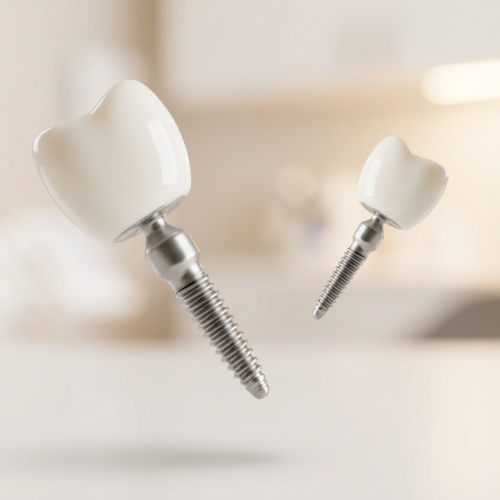
Mini dental implants offer a less invasive path to tooth replacement, but they come with real mechanical limitations and ongoing maintenance that most patients don't hear about upfront. Understanding bite-force thresholds, hardware wear cycles, and removal risks helps you make a genuinely informed decision. If you're exploring dental implants as a tooth replacement option, the details below will help you ask the right questions before committing.
For Bellflower patients, not all tooth positions are equal — and this is where many patients get surprised after placement.
A Healthline overview of mini dental implants notes that mini implants measure less than 3 millimeters in diameter, compared to traditional implants at 3.25 to 5 mm. That size difference matters enormously depending on where in your mouth the implant needs to go.
Here's the biomechanical reality: your anterior (front) teeth generate roughly 30–50 lbs of bite force. Your molars generate 150–250 lbs. A titanium post under 3 mm in diameter simply wasn't engineered to absorb that kind of repeated stress in a posterior position. Over time, cyclical molar loading creates metal fatigue — and fatigue fractures in narrow-diameter posts are a documented clinical concern.
This is why mini implants are generally considered contraindicated for standalone molar replacements. They're well-suited for front teeth, lower incisors with limited bone width, and as anchors to stabilize overdentures — positions where force loads are distributed or substantially lower.
Patients with diagnosed nocturnal bruxism face compounded risk. Grinding concentrates peak forces on implant posts during sleep, when there's no conscious muscle control. Mayo Clinic's overview of dental implant surgery lists teeth grinding as a factor that can affect implant outcomes. For mini implants specifically, the narrower post has less material cross-section to absorb those forces — making bruxism a meaningful contraindication.
Before any placement decision, your dentist should map exactly which tooth position needs restoration and what your bite generates at that location.
Upfront placement is only part of the picture when mini implants anchor an overdenture.
Mini implant overdentures use a snap-retention system: a small ball on top of each implant post fits into a rubber O-ring and metal housing embedded in the denture base. Healthline's guide to snap-in dentures confirms that attachments loosen over time and require periodic tightening or replacement — a detail that often gets glossed over during initial consultations.
O-ring gaskets typically degrade every 6–18 months depending on chewing habits, denture hygiene, and how many implants share the load. When they wear out, the snap-retention weakens noticeably. Female housing caps — the metal components embedded in the denture — can also wear and may need replacement on a similar or longer cycle. Each service visit to replace these components adds to your total investment over time.
Beyond hardware, dentures re-alignments (relines) are periodically necessary as the underlying jawbone gradually changes shape. This is true of conventional dentures too, but with implant-retained overdentures the fit between the snap attachments and the denture base must stay precise to avoid uneven stress on the implant posts.
The practical takeaway: budget for recurring maintenance appointments — not just the initial procedure. Ask your provider specifically how often O-rings and housings typically need replacement in their patient population, and what those appointments involve. A 5-to-10-year view of upkeep visits gives a far more accurate picture of total commitment than placement day alone.
This is the conversation most patients never have before saying yes.
Traditional two-piece implants separate the post from the abutment. If the abutment wears or fractures, a dentist unscrews it and replaces the component — the integrated bone structure stays intact. Mini implants are one-piece (monobloc) designs. The ball head and the post are a single unit. If that ball head wears down or the post fractures, there is no component swap available.
Removing a failed one-piece mini implant requires a procedure called trephining — cutting a cylinder of bone away around the integrated post to free it. Research published via the NIH's StatPearls acknowledges that while mini implants are associated with easier removal than conventional implants in some cases, surgical trauma is still a factor. For patients who chose mini implants precisely because they had limited bone density, losing additional bone volume during trephine removal significantly narrows future options. In some cases, a tooth extraction of the failed implant may be the necessary path forward, and replacing the failed mini implant with another, or transitioning to a traditional implant, becomes more complex after that bone loss occurs.
This doesn't make mini implants a poor choice — it makes full informed consent essential. Understanding the removal scenario before placement lets you weigh it properly against the genuine advantages: less invasive surgery, faster recovery, no bone grafting required in many cases, and same-day tooth crown placement in appropriate candidates.
WebMD's overview of dental implants for seniors notes that implants generally offer strong long-term outcomes, but each patient's anatomy and health profile shapes what "long-term" actually looks like. For mini implants specifically, longevity data is still maturing compared to the decades of evidence behind traditional implants.
Mini implants can last many years when placed in appropriate positions and maintained properly. The post itself, once osseointegrated into the jawbone, can remain stable for a decade or longer in well-selected candidates. Healthline's piece on how long dental implants last explains that osseointegration — the process of bone fusing to the implant surface — is what gives any implant its long-term stability.
The variables that most affect mini implant longevity:
The honest answer is that mini implants are not automatically a permanent solution in the same way traditional implants aim to be. They're a clinically valuable option for specific patients and specific positions — and with the right candidate, proper placement, and consistent maintenance, they can provide stable, functional results for many years.
If you're considering mini dental implants in the Bellflower area, a thorough evaluation is the only way to know whether your bone density, bite position, and health profile make you a good candidate. Bellflower Dental Group serves patients throughout Southeast Los Angeles — including Bellflower and Downey — and can walk you through your implant options with a complete picture of what each involves, from placement through long-term care. If a dental emergency involving a failing implant or damaged restoration brings you in sooner, the team is equipped to help with that as well.
This article is for informational purposes only and does not constitute dental or medical advice. Individual results vary. Consult a licensed dental professional to determine the treatment approach appropriate for your specific situation.
Fresh news from the dental world...



Mon - Fri 9AM - 6PM
Saturday 9AM - 3PM
Sunday Closed
Check out what our patients are saying in Bellflower, CA...


“Great customer service!”
Great customer service and attentive staff! My 3 year old enjoyed his visit! Yes, I said he enjoyed it! He had to have X-rays done, and I was so worried that he wasn't gonna be a happy camper but the X-ray tech, Dominique, is so good with kids! The X-rays were fast and painless! Overall a great experience!

“Surpasses my expectations!”
Amazing staff! My experience at Bellflower Dental Group was outstanding. I highly recommend this dental group. I come to them for my braces, their ortho is incredible, the highlight of this dental group. The staff is amazing, their employees are so kind and take the time to perfect your braces.

“I love this dental office!”
I have been coming here for years. It is a one-stop-shop! You can get your x-rays, cleaning, braces, labs, dentures, toothbrushes, and more all right here. The staff is great, and they try to work with you if you need a payment plan. Never had any issues with any of the work done here!
“Great customer service!”
Great customer service and attentive staff! My 3 year old enjoyed his visit! Yes, I said he enjoyed it! He had to have X-rays done, and I was so worried that he wasn't gonna be a happy camper but the X-ray tech, Dominique, is so good with kids! The X-rays were fast and painless! Overall a great experience!
“Surpasses my expectations!”
Amazing staff! My experience at Bellflower Dental Group was outstanding. I highly recommend this dental group. I come to them for my braces, their ortho is incredible, the highlight of this dental group. The staff is amazing, their employees are so kind and take the time to perfect your braces.
Check out our accreditations, sources, and relationships in the wide world of dentistry...


Check us out and follow our Bellflower, CA practice on social media...


