
Is Spark Aligner Better Than Invisalign and How Do They Compare?
Spark Aligner vs Invisalign: Discover which clear aligner is cheaper, how they compare, and their key differences. Read our guide and schedule your visit today!
Read More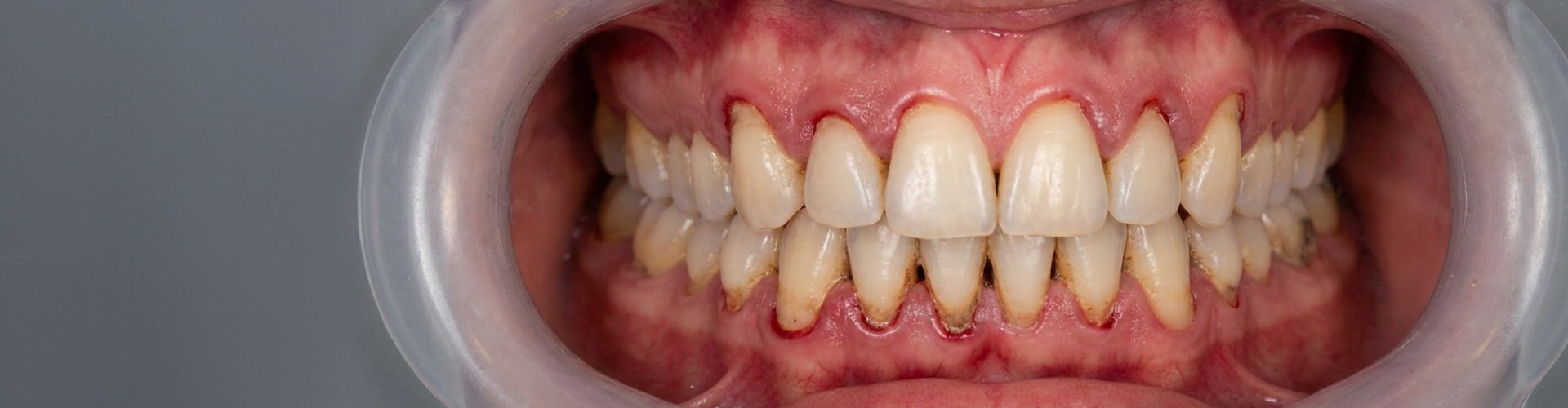
Gum disease often develops without pain, making early warning signs easy to dismiss. Bleeding gums and persistent bad breath are two of the most recognizable signals — but some of the most important warning signs, especially for smokers and vapers, are completely invisible without knowing what to look for. For Bellflower-area patients, understanding gum disease and its early indicators can make the difference between simple treatment and serious intervention.
Most people picture receding gums as a dramatic, visible change. In reality, the earliest recession happens in a place most people never examine closely — the tiny triangle of pink tissue between your teeth called the interdental papilla.
When this tissue is healthy, it fills the space between teeth completely, acting as a natural barrier against food debris. When it begins to break down due to gum inflammation, that space opens up. You'll notice it in a very practical way: fibrous foods like steak, broccoli, or apple skins suddenly start getting wedged between teeth that never trapped food before.
This isn't just annoying. It's a physical signal that the papilla has shrunk enough to create a funnel for debris — and the bacteria that follow accelerate the destruction further.
The distinction matters. A loose contact between two teeth (where a tooth crown or filling has shifted slightly) will cause food to slip through easily and fall out just as easily. Active papilla loss creates a tighter, more frustrating trap — food gets packed in and requires a toothpick or floss to remove. If you're suddenly fighting food impaction in your back teeth, it's worth bringing up at your next dental visit. It may be the earliest visible sign of gum disease you can detect at home.
According to WebMD, nearly half of adults over 30 show signs of gum disease — and most don't realize it until the disease has already progressed.
If you smoke or vape and you're checking your gums for early warning signs, you may be looking for the wrong thing entirely.
Bleeding gums are one of the most commonly cited signs of gingivitis. But nicotine is a powerful vasoconstrictor — it narrows the blood vessels in gum tissue, reducing blood flow. The result: your gums may not bleed even when they're severely inflamed and actively losing bone support. A lack of bleeding is not a clean bill of health. It's a false negative.
The NIDCR confirms that smoking is the single most significant risk factor for gum disease — and also makes treatment less effective. Yet smokers are often the last to notice something is wrong because their primary warning sign is suppressed.
For tobacco and vape users, the warning signs to watch instead include:
If you vape and believe it's safer for your gums than cigarettes, the vasoconstriction mechanism is similar. Nicotine delivery, regardless of the source, still masks the bleeding that would otherwise signal early disease. Scheduling a routine cleaning and exam is especially critical for smokers and vapers who can't rely on bleeding as a warning signal.
Bleeding gums can absolutely signal gum disease — but the full answer is more nuanced, and getting it wrong causes real harm.
Many people start flossing when they notice bleeding, see more blood, assume they're making things worse, and stop entirely. That cycle leaves the underlying inflammation untreated.
Here's what's actually happening. Mouthhealthy.org explains that if you've just started a new flossing routine, bleeding may occur as gums adjust to the disruption of accumulated plaque along the gumline. This is inflammatory bleeding — your body's immune response flushing bacteria from irritated tissue. It's not damage you're causing.
A rough timeline of what to expect:
If bleeding continues beyond two weeks of consistent, gentle flossing, that's the signal to call your dentist. Persistent bleeding after a proper hygiene routine is no longer about technique — it points to inflammation that needs professional attention. In some cases, untreated gum disease can progress to the point where a tooth extraction becomes necessary, making early intervention all the more important.
Technique matters too. Trauma bleeding looks different: it's immediate, sharp, and localized to a single spot where floss was snapped down too hard against the gumline. Inflammatory bleeding is more diffuse and appears at multiple sites. Curve the floss in a "C" shape around each tooth and slide gently under the gumline rather than snapping it straight down.
Yes — and it's one of the more reliable indicators that something beyond diet or dry mouth is happening.
Harvard Health notes that periodontal disease is the leading cause of tooth loss in adults, but its effects extend well beyond the mouth. The bacteria responsible for gum disease produce volatile sulfur compounds as a byproduct of breaking down proteins in gum tissue. These compounds — hydrogen sulfide and methyl mercaptan — are the primary drivers of chronic bad breath that doesn't respond to brushing, mouthwash, or mints.
The difference between ordinary bad breath and gum disease-related halitosis is persistence. Garlic breath fades. Morning breath clears with brushing. But bad breath rooted in active periodontal pockets tends to return within hours of brushing because the bacterial source lives below the gumline, where a toothbrush can't reach.
Other early warning signs worth knowing, alongside bad breath:
Research from Healthline reinforces that gum inflammation from inadequate plaque removal is a primary driver of both bleeding and the bacterial buildup behind chronic halitosis. Treating the disease — not masking the symptom — is the only lasting fix. When gum disease has advanced significantly, an endodontic root canal or other restorative treatment may be needed to address damage to the surrounding tooth structure.
The good news: when caught early, gingivitis is fully reversible with a professional cleaning and consistent home care. The earlier the intervention, the less damage there is to undo.
If any of these warning signs sound familiar — food suddenly trapping between teeth, gums that bleed when you floss, or bad breath that won't quit — don't wait to see if it clears up on its own. Bellflower Dental Group serves patients throughout Bellflower and the greater Southeast Los Angeles area, including Downey. A periodontal evaluation can catch early-stage gum disease before it becomes a much more serious problem. If you're experiencing a dental emergency related to advanced gum disease, our office is here to help. Contact our office to schedule your visit.
This article is intended for informational purposes only and does not constitute professional dental or medical advice. Please consult a licensed dental provider for diagnosis and treatment recommendations specific to your situation.
Fresh news from the dental world...



Mon - Fri 9AM - 6PM
Saturday 9AM - 3PM
Sunday Closed
Check out what our patients are saying in Bellflower, CA...


“Great customer service!”
Great customer service and attentive staff! My 3 year old enjoyed his visit! Yes, I said he enjoyed it! He had to have X-rays done, and I was so worried that he wasn't gonna be a happy camper but the X-ray tech, Dominique, is so good with kids! The X-rays were fast and painless! Overall a great experience!

“Surpasses my expectations!”
Amazing staff! My experience at Bellflower Dental Group was outstanding. I highly recommend this dental group. I come to them for my braces, their ortho is incredible, the highlight of this dental group. The staff is amazing, their employees are so kind and take the time to perfect your braces.

“I love this dental office!”
I have been coming here for years. It is a one-stop-shop! You can get your x-rays, cleaning, braces, labs, dentures, toothbrushes, and more all right here. The staff is great, and they try to work with you if you need a payment plan. Never had any issues with any of the work done here!
“Great customer service!”
Great customer service and attentive staff! My 3 year old enjoyed his visit! Yes, I said he enjoyed it! He had to have X-rays done, and I was so worried that he wasn't gonna be a happy camper but the X-ray tech, Dominique, is so good with kids! The X-rays were fast and painless! Overall a great experience!
“Surpasses my expectations!”
Amazing staff! My experience at Bellflower Dental Group was outstanding. I highly recommend this dental group. I come to them for my braces, their ortho is incredible, the highlight of this dental group. The staff is amazing, their employees are so kind and take the time to perfect your braces.
Check out our accreditations, sources, and relationships in the wide world of dentistry...


Check us out and follow our Bellflower, CA practice on social media...


