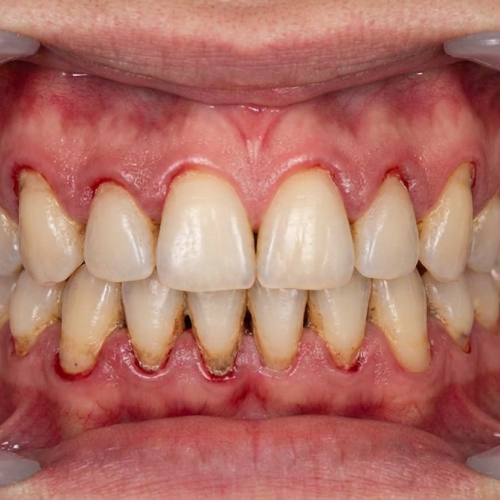
Early Warning Signs of Gum Disease: Bleeding, Bad Breath, and the Signals You're Missing
Are your gums bleeding or is bad breath lingering? Learn the warning signs of gum disease and schedule your checkup at Bellflower Dental Group today.
Read More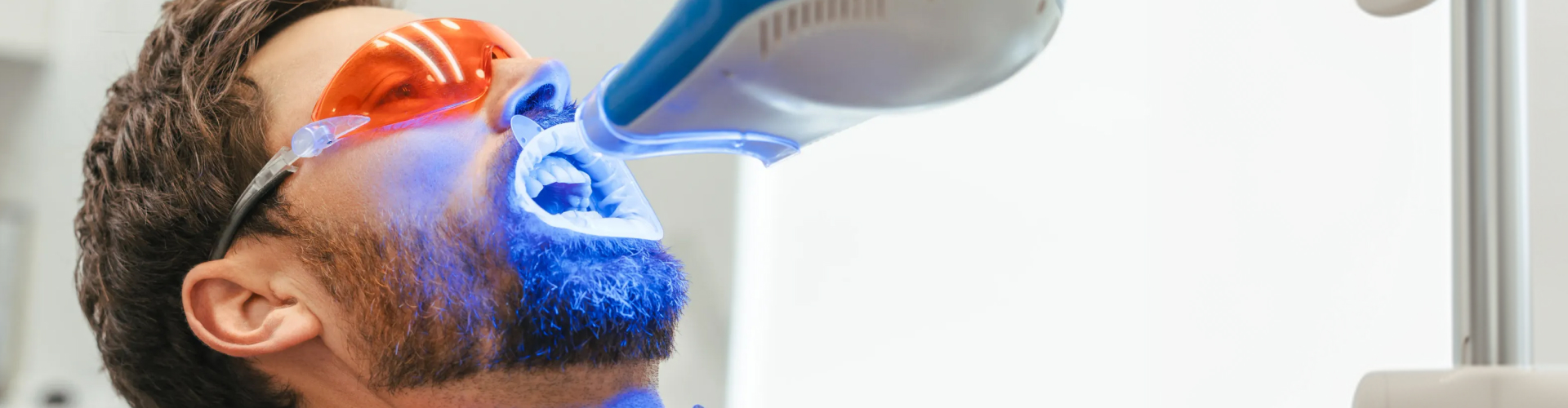
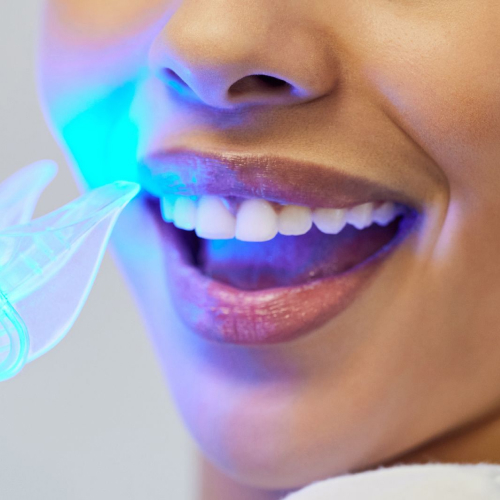
An in-office whitening session typically runs 45 to 90 minutes, but the result you see leaving the chair isn't your final shade — your teeth need 48 hours to rehydrate before the true color settles. At-home professional trays take longer overall but deliver comparable long-term results.
This is the part most patients don't hear about before their appointment. For Bellflower-area patients, understanding the biological timeline is key to managing expectations.
During professional in-office whitening, high-concentration hydrogen peroxide — typically 25% to 40% — temporarily dehydrates your enamel. According to WebMD, keeping a high-percentage peroxide solution on teeth longer than needed will dehydrate them and increase sensitivity. That dehydration effect is real, and it creates what's sometimes called a "dehydrated shade" — a chalky, almost unnaturally bright white that looks spectacular in the mirror but isn't stable yet.
Here's the actual timeline:
Patients who don't know this sometimes feel the treatment underperformed. It didn't. The 48-hour rebound is normal biology, not a sign of failure.
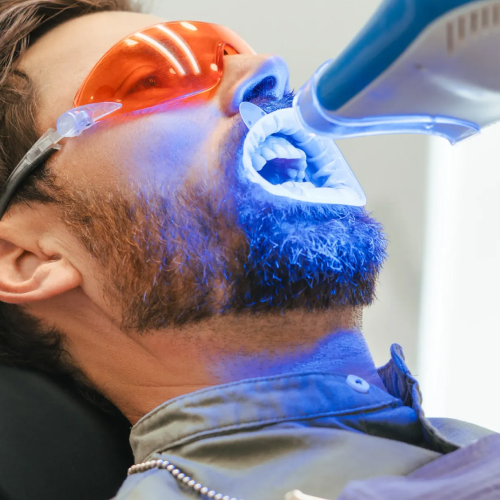
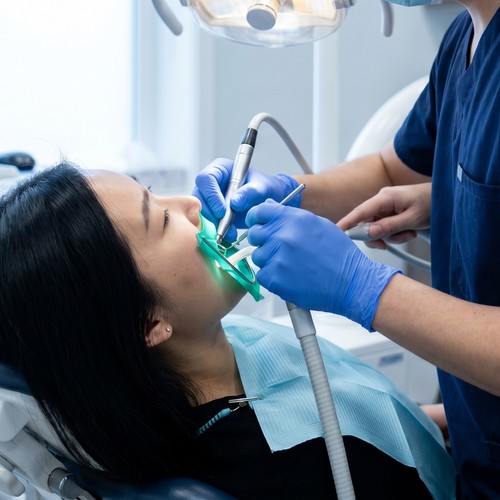
A typical in-office session at a dental practice runs between 45 and 90 minutes from start to finish. Harvard Health notes that achieving the desired color usually takes three to four sessions of 30 to 60 minutes each, though single-visit power bleaching techniques using highly concentrated hydrogen peroxide are also available.
The general process looks like this:
The process is non-invasive. Most patients experience mild sensitivity during or after, which Healthline describes as temporary and linked to the peroxide temporarily affecting the tooth's inner layers.
Not every patient leaves with the same result, and understanding why matters before you book an appointment.
Professional whitening works by breaking down chromophores — large organic molecules responsible for tooth color — through oxidation. Research published in PMC confirms that once hydrogen peroxide oxidizes those double-bond structures, the chromogen lightens. But every person has a biological saturation point. Once the accessible chromophores are fully broken down, no additional gel application will produce a whiter result.
A few practical markers help identify when you're approaching that ceiling:
It's also worth knowing that whitening only affects natural tooth enamel. Tooth crowns, veneers, bonding, and tooth-colored fillings won't respond to peroxide. The ADA notes that intrinsic staining from sources like fluorosis, tetracycline use, or genetic conditions may require alternative cosmetic approaches beyond bleaching. In those cases, porcelain veneers are often considered as a way to achieve a uniformly bright smile when bleaching alone isn't sufficient.
The appointment ending doesn't mean the biological process is finished.
Professional whitening temporarily removes the acquired pellicle — a thin protective protein film that naturally coats your enamel. Until that film regenerates (roughly 24 hours), your teeth are unusually porous and absorb pigment more readily than normal. This is the most critical window for protecting your result.
A practical recovery roadmap:
Studies comparing in-office and at-home systems show that results from both approaches converge significantly by the six-month mark, which means how well you protect the result in the first 24 hours has a real impact on long-term outcome.
Bellflower Dental Group serves patients throughout Bellflower and the broader Southeast Los Angeles area, including Downey. If you're considering professional whitening, our team can evaluate your enamel, identify the type of staining you have, and recommend the approach most likely to reach your personal saturation point — without over-treating. For patients interested in a complete smile transformation, we also offer aesthetic dentistry services that go beyond whitening to address shape, alignment, and overall appearance. Contact us to schedule a consultation.
This article is for informational purposes only and does not constitute dental or medical advice. Individual results vary. Consult a licensed dental professional before beginning any whitening treatment.
Fresh news from the dental world...


Mon - Fri 9AM - 6PM
Saturday 9AM - 3PM
Sunday Closed
Check out what our patients are saying in Bellflower, CA...


“Great customer service!”
Great customer service and attentive staff! My 3 year old enjoyed his visit! Yes, I said he enjoyed it! He had to have X-rays done, and I was so worried that he wasn't gonna be a happy camper but the X-ray tech, Dominique, is so good with kids! The X-rays were fast and painless! Overall a great experience!

“Surpasses my expectations!”
Amazing staff! My experience at Bellflower Dental Group was outstanding. I highly recommend this dental group. I come to them for my braces, their ortho is incredible, the highlight of this dental group. The staff is amazing, their employees are so kind and take the time to perfect your braces.

“I love this dental office!”
I have been coming here for years. It is a one-stop-shop! You can get your x-rays, cleaning, braces, labs, dentures, toothbrushes, and more all right here. The staff is great, and they try to work with you if you need a payment plan. Never had any issues with any of the work done here!
“Great customer service!”
Great customer service and attentive staff! My 3 year old enjoyed his visit! Yes, I said he enjoyed it! He had to have X-rays done, and I was so worried that he wasn't gonna be a happy camper but the X-ray tech, Dominique, is so good with kids! The X-rays were fast and painless! Overall a great experience!
“Surpasses my expectations!”
Amazing staff! My experience at Bellflower Dental Group was outstanding. I highly recommend this dental group. I come to them for my braces, their ortho is incredible, the highlight of this dental group. The staff is amazing, their employees are so kind and take the time to perfect your braces.
Check out our accreditations, sources, and relationships in the wide world of dentistry...


Check us out and follow our Bellflower, CA practice on social media...


