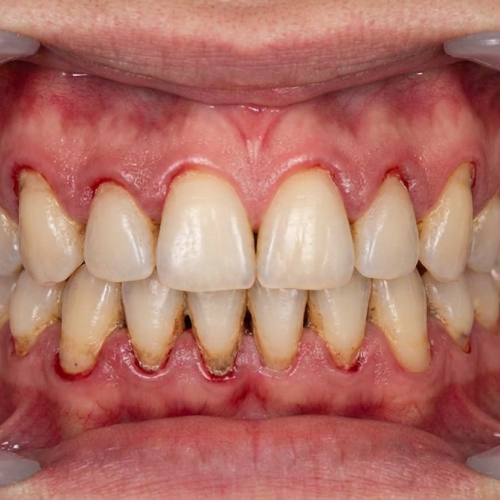
Early Warning Signs of Gum Disease: Bleeding, Bad Breath, and the Signals You're Missing
Are your gums bleeding or is bad breath lingering? Learn the warning signs of gum disease and schedule your checkup at Bellflower Dental Group today.
Read More
Ozone therapy is a legitimate, science-backed adjunct in endodontics, but it cannot replace a root canal once the pulp is irreversibly damaged or necrotic. Whether ozone saves your nerve or simply makes your root canal more effective depends entirely on the biological state of your pulp — something only a clinical exam can determine.
The single most important thing I want patients to understand is this: ozone does not resurrect dead tissue. It sterilizes. For Bellflower-area patients, that distinction changes everything about what ozone can and cannot do for your tooth.
When I evaluate a tooth with deep decay or persistent sensitivity, I'm making a very specific diagnostic decision. Is this reversible pulpitis — meaning the nerve is inflamed but still alive and capable of healing? Or has the pulp crossed into irreversible pulpitis or necrosis, where the tissue is dying or already dead?
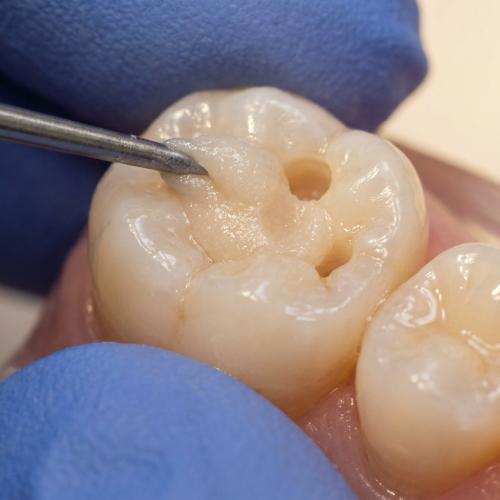
In reversible pulpitis, the nerve responds to stimuli but settles down. There's no spontaneous throbbing pain at night. Radiographs show no periapical lesion. In these cases, ozone applied to the cavity preparation — followed by a biocompatible pulp-capping material and a sealed restoration — gives the pulp a genuine chance to recover. Research published in PMC confirms that ozone application over deep carious lesions shows no harmful effects on pulpal tissue and supports lesion disinfection before the pulp is exposed.
Once you cross into irreversible pulpitis — spontaneous pain, no relief with cold, a periapical shadow on X-ray — the nerve cannot heal. Ozone applied at that stage functions only as a powerful disinfectant during root canal treatment, not as a substitute for it. Waiting and hoping ozone alone will "fix" a necrotic nerve risks a spreading abscess. That's a clinical reality I won't soften.
The diagnostic checklist is straightforward: lingering pain beyond 30 seconds after stimulus, spontaneous nocturnal pain, and radiographic bone loss all point past the threshold where ozone saves the nerve. At that point, we move forward with root canal therapy — and ozone still plays a meaningful role inside the canal.
Here's the physics-based reason ozone matters even during a conventional root canal — and it comes down to surface tension.
Traditional liquid irrigants like sodium hypochlorite have measurable surface tension. That means they struggle to flow into the microscopic lateral canals and dentinal tubules branching off the main canal. According to WebMD's review of ozone therapy research, ozone has been studied for over a century as an antimicrobial agent precisely because of its unique oxidative chemistry. Because ozone is a gas, it has effectively zero surface tension — it permeates porous tooth structure and reaches areas where liquid simply cannot flow under normal clinical conditions.
The primary pathogen I'm targeting in a failing root canal is Enterococcus faecalis, a gram-positive bacterium that invades dentinal tubules and survives standard irrigation. Cleveland Clinic notes that while ozone therapy shows genuine promise as an antimicrobial agent, its delivery protocol matters enormously — which brings me to how we actually administer it safely.
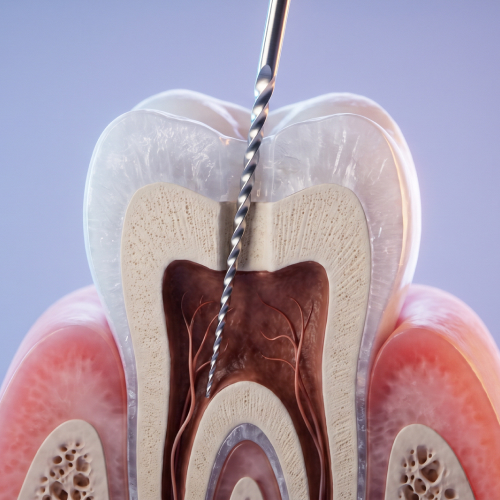
Ozone gas, when delivered through a sealed tip placed into the canal, physically displaces oxygen-depleted air and oxidizes bacterial cell membranes on contact. It disrupts lipids, proteins, and nucleic acids simultaneously — a mechanism bacteria cannot develop resistance to, unlike antibiotics. When combined with ultrasonic irrigation, the antimicrobial effect is enhanced further by the agitation driving ozone-saturated fluid into the canal architecture.
I want to be transparent about the evidence here: a systematic review found that ozone alone provides less microbial reduction than sodium hypochlorite as a standalone agent. That's why I don't position ozone as a replacement for NaOCl — I use it as a complement, capturing the penetration advantage of gas while maintaining the tissue-dissolving power of traditional irrigants.
The safety question patients ask most often is "Is ozone safe for my tooth?" The more important clinical question is actually: "Is the delivery protocol protecting my lungs?"
Ozone is a potent respiratory irritant. The JADA (Journal of the American Dental Association) has noted that evidence quality for ozone in root canal disinfection requires careful procedural standardization — and that standardization is largely about containment, not chemistry.
At our practice, chairside ozone administration follows a specific protocol. We use a sealed suction delivery system — never an open-spray method — which captures gas before it can disperse into the operatory air. High-volume evacuation (HVE) tips run continuously during application. For patients with asthma, reactive airway disease, or respiratory sensitivities, we discuss this protocol explicitly before proceeding, because even trace inhalation can trigger bronchospasm.
The gas itself has a half-life of roughly 40 minutes at room temperature, decomposing back into ordinary oxygen. That instability is actually a safety feature — ozone generated for a procedure cannot accumulate or persist in the room. But it does mean our generator must produce fresh ozone immediately before each use; it cannot be bottled or stored.
For periodontal applications — flushing infected pockets with ozonated water — the inhalation risk is lower, since aqueous ozone off-gasses far less than pure gas. Research published in PMC on ozone in periodontal therapy found meaningful reductions in pocket depth and microbial load when ozone was used as an adjunct to scaling and root planing, with no reported adverse events in clinical settings. Patients dealing with gum disease may particularly benefit from this adjunctive approach when combined with professional debridement.
The short answer on safety: ozone is safe when the delivery system is properly engineered. It is not safe when administered casually or through open-air systems that allow inhalation.
Across the full scope of dental care, ozone therapy has demonstrated genuine clinical value in several categories:
Caries management: For early and non-cavitated lesions, ozone application followed by remineralizing agents has shown strong results. A clinical trial reviewed in PMC found that ozone-oxygen mixtures effectively reduce cariogenic bacteria including Streptococcus mutans and support remineralization of early lesions — potentially avoiding a cavity filling entirely.
Root canal adjunct: As described above, ozone's zero-surface-tension gas delivery makes it a meaningful complement to standard chemomechanical preparation, particularly against biofilm-forming organisms in lateral canals.
Post-surgical healing: Ozone promotes soft tissue healing by increasing local oxygenation, stimulating fibroblast activity, and modulating inflammatory pathways. For patients who have undergone extractions or implant placement, ozonated water rinses and gel applications can meaningfully reduce postoperative discomfort. Patients who have recently had a tooth extraction may find ozone-assisted protocols support faster, more comfortable recovery.
Periodontal therapy: When combined with scaling and root planing, ozonated water irrigation into periodontal pockets reduces anaerobic bacterial load in a way that mechanical debridement alone cannot fully achieve.
What ozone cannot do: replace root canal therapy on a necrotic tooth, eliminate the need for professional mechanical debridement, or cure established periapical infections without surgical or endodontic intervention.
My approach at Bellflower Dental Group is to use ozone where the evidence supports it — as a precision tool that makes conservative treatment more effective, or that makes necessary treatment less traumatic. It is not a philosophy. It is a clinical instrument.
If you're in Bellflower or the surrounding Southeast Los Angeles area and you're trying to decide between saving a tooth conservatively or moving forward with root canal therapy, the first step is an honest diagnostic conversation — not a guess.
At Bellflower Dental Group, our multi-specialty team evaluates pulp vitality, infection staging, and your full medical history before recommending any treatment. We'll tell you clearly whether ozone can protect your nerve, whether it belongs in your root canal protocol, or whether the biology of your tooth has already made that decision for us. Schedule a cleaning and exam to get a comprehensive picture of your oral health and discuss whether ozone therapy belongs in your care plan.
Contact us to schedule a consultation. We'll give you a straight answer.
Medical disclaimer: This article is intended for educational purposes only and does not constitute individualized dental or medical advice. Clinical outcomes vary based on individual patient anatomy, health history, and disease presentation. Always consult a licensed dental professional for diagnosis and treatment recommendations specific to your situation.
Fresh news from the dental world...


Mon - Fri 9AM - 6PM
Saturday 9AM - 3PM
Sunday Closed
Check out what our patients are saying in Bellflower, CA...


“Great customer service!”
Great customer service and attentive staff! My 3 year old enjoyed his visit! Yes, I said he enjoyed it! He had to have X-rays done, and I was so worried that he wasn't gonna be a happy camper but the X-ray tech, Dominique, is so good with kids! The X-rays were fast and painless! Overall a great experience!

“Surpasses my expectations!”
Amazing staff! My experience at Bellflower Dental Group was outstanding. I highly recommend this dental group. I come to them for my braces, their ortho is incredible, the highlight of this dental group. The staff is amazing, their employees are so kind and take the time to perfect your braces.

“I love this dental office!”
I have been coming here for years. It is a one-stop-shop! You can get your x-rays, cleaning, braces, labs, dentures, toothbrushes, and more all right here. The staff is great, and they try to work with you if you need a payment plan. Never had any issues with any of the work done here!
“Great customer service!”
Great customer service and attentive staff! My 3 year old enjoyed his visit! Yes, I said he enjoyed it! He had to have X-rays done, and I was so worried that he wasn't gonna be a happy camper but the X-ray tech, Dominique, is so good with kids! The X-rays were fast and painless! Overall a great experience!
“Surpasses my expectations!”
Amazing staff! My experience at Bellflower Dental Group was outstanding. I highly recommend this dental group. I come to them for my braces, their ortho is incredible, the highlight of this dental group. The staff is amazing, their employees are so kind and take the time to perfect your braces.
Check out our accreditations, sources, and relationships in the wide world of dentistry...


Check us out and follow our Bellflower, CA practice on social media...


